Practice / AI Strategy and Transformation
AI Strategy and Transformation
Decide where AI creates value and redesign the work to deliver it.
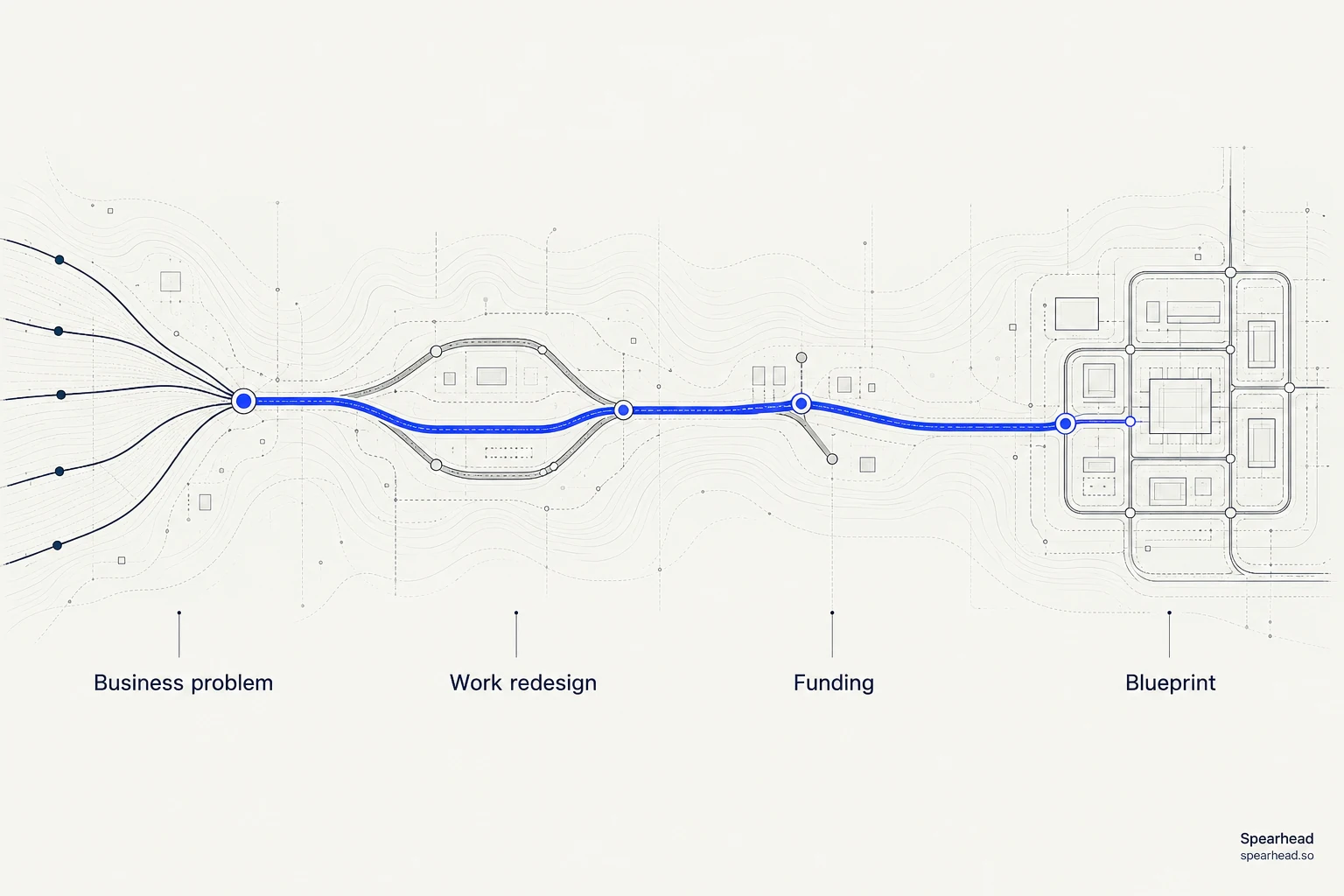
The work in context
How this practice helps
An AI investment needs a business decision behind it: what should improve, which work must change, and what would make the investment worthwhile. We connect those decisions to a solution your engineering team can build. The starting point can be an uncertain opportunity, a defined workflow, or an existing program whose value is unclear.
Teams often have a growing list of ideas, several pilots, and different views of the priority. A sponsor needs an understandable basis for choosing. Technical teams need clearer requirements. People doing the work need to see how the change affects their responsibilities. Bringing those questions together prevents the roadmap from becoming a collection of disconnected experiments.
A view of the work
The connections that matter
- 01Business problem
- 02Work redesign
- 03Value and funding
- 04Buildable blueprint
Working together
What the work involves
- 01
Discovery
Assess the current situation through workflow review, stakeholder conversations, and available evidence. Identify opportunities, dependencies, and reasons to defer work. The assessment scope and decision output are agreed before starting.
- 02
AI Solution Blueprinting
Translate a selected problem into a current-state baseline, future workflow, requirements, platform evaluation, and implementation sequence. Discovery included in a blueprint has an explicit boundary so the same work is not sold twice.
- 03
Value and AI FinOps
Build a view of business value and full AI cost, including integration, evaluation, operating support, and adoption. Agree on who owns measurement and distinguish projected value from outcomes verified after deployment.
- 04
Work redesign
Examine changes to tasks, handoffs, judgment, and roles. FAR (Fix, Accelerate, Reimagine) places each option at a level of ambition.
- 05
A decision that leads to delivery
Bring the sponsor, workflow owner, engineering, and governance together around the investment decision. Identify what must be proved before release and what should wait for evidence from the first implementation.
Outputs and decisions
What you can take forward
- A scoped opportunity assessment and decision record.
- A blueprint with requirements, dependencies, and an implementation sequence.
- A value-and-cost model with assumptions and measurement ownership.
- Proposed workflow and responsibility changes.
Illustrative example
Illustrative decision
A service organization considering an assistant could compare improving access to approved guidance with redesigning escalation. The blueprint would specify the workflow, source permissions, human decisions, evaluation, and operating owner before a build is funded.
Illustrative scenario, not a reported client result or a product capability claim.
Scope and responsibility
Agree on the scope
Business operating-model and work-redesign decisions sit here. Engineering ways of working sit in AI Engineering; governance decision rights and controls sit in AI Governance. An engagement can connect all three, with one agreed scope. Discovery is not automatically a fixed standalone package, and a blueprint does not constitute a production implementation.
Practical questions
Before you begin
Do we need to begin with a workshop?
No. The entry point follows your decision. A defined architecture problem or existing pilot can start directly with the relevant engineering work.
Will you select the technology?
Blueprinting can include vendor-neutral platform evaluation against agreed scenarios. The choice should follow the workflow and constraints, with the reasons recorded.
How do we know the work is complete?
Agree on the required decisions and outputs at the outset. Acceptance is a review of those outputs and remaining assumptions, rather than a promise that a roadmap has already delivered value.
Explore this practice
Find the work you need
- Discovery
Where should you act first? Discovery connects an AI opportunity to the work, evidence and constraints behind it, so your next investment decision has a defensible starting point.
- AI Solution Blueprinting
What should the future workflow look like, and what will it take to build? A blueprint connects business outcomes, user experience, operating decisions and technology requirements so teams can make an informed implementation decision.
- Value and AI FinOps
Is your AI spending creating the value you need? Connect workflow outcomes with the full cost of AI, then make a grounded decision about what to fund, improve or stop.
- Work Redesign using FAR
Which parts of the work should change? The FAR approach (Fix, Accelerate, Reimagine) provides a proposed way to compare intervention choices, from removing a workflow defect to designing a different operating approach.
Next step
Start with the work you want to change.
Bring the decision you need to make, the workflow it affects, and the evidence you have. We can scope the next piece of work.
Discuss your priorities