Practice / AI Engineering
AI Engineering
Establish the engineering capability and build systems your teams can operate.
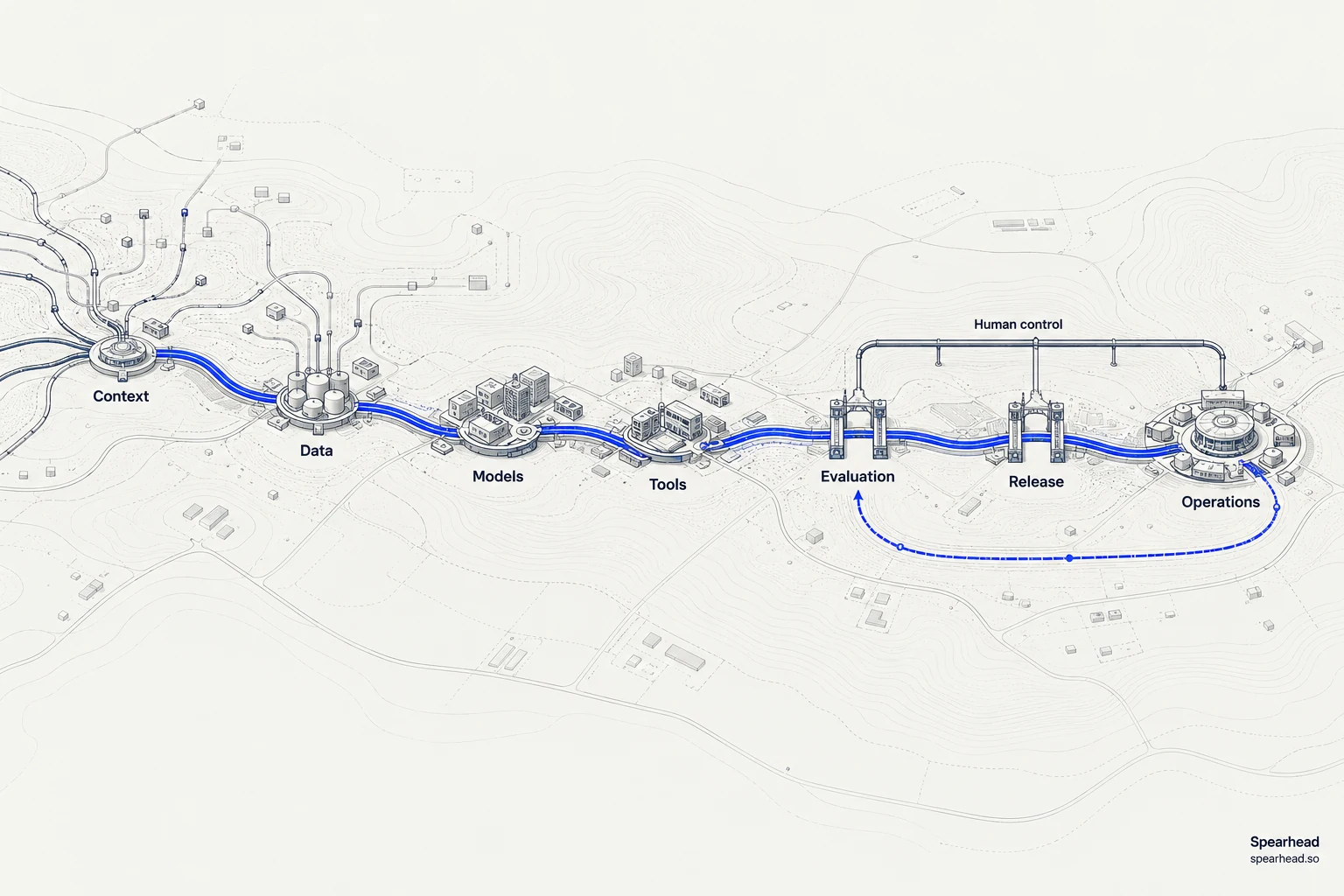
The work in context
How this practice helps
A useful AI system combines more than a model. It needs the right context, authorized data, reliable integrations, evaluation, and an operating owner. We connect those parts to a defined workflow, then help your team release and maintain the system. You can begin with a new build, an architecture decision, or a pilot that needs to become a production product.
An early demonstration can hide the hardest engineering questions. What happens when the source is incomplete? Which action needs approval? How does a changed model affect quality? Who can diagnose a failed tool call? Answering these questions during delivery makes the system understandable to the people who will inherit it.
A view of the work
The connections that matter
- 01Context and data
- 02Models and tools
- 03Evaluation and release
- 04Operations and ownership
Working together
What the work involves
- 01
Engineering operating model
Define delivery responsibilities, the toolchain, review points, evaluation ownership, and release authority. This concerns engineering ways of working; enterprise work redesign belongs in Strategy and Transformation.
- 02
AI-native software delivery
Design a development lifecycle around requirements, architecture, assisted implementation, evaluation, quality assurance, and release. Software Factory work can cover advisory design, a bounded implementation, or rollout; those are separately scoped.
- 03
Architecture and agents
Connect model access, enterprise data, identity, tools, and controls. Build agents and copilots only where their permissions and evaluation fit the workflow. Explain what the system can do and where a person must decide.
- 04
Workflow implementation
Start with one bounded operational problem. Agree on the data, integrations, quality criteria, exception handling, and owner. Tech Support, Legal, Supply Chain, and HR are implementation directions whose specific scope must be defined.
- 05
Production readiness and transfer
Harden the system, establish monitoring and runbooks, check release conditions, and prepare the client team. Build, Operate, Transfer can be scoped with a defined handover, rather than leaving ownership to the end.
Outputs and decisions
What you can take forward
- A system design and documented integration boundaries.
- A working implementation evaluated against agreed scenarios.
- Release evidence, monitoring, and operational runbooks.
- An ownership and capability-transfer plan.
Illustrative example
Illustrative system cutaway
For a support assistant, the architecture connects an authenticated engineer to permitted knowledge, a model gateway, retrieval, evaluation, and approved tools. Suggested actions remain reviewable; privileged changes require a separate authorization path.
Illustrative scenario, not a reported client result or a product capability claim.
Scope and responsibility
Agree on the scope
Engineering implements agreed controls; Governance defines their policy and decision requirements. Software Factory capability is not presented as a delivered client factory case. Support coverage, operating period, access, and transfer dates are agreed for each engagement. An engineering build does not establish an unlimited maintenance service.
Practical questions
Before you begin
Can you take over an existing pilot?
Yes, productization is an explicit entry path. We first inspect the build, access, dependencies, evaluation, and ownership to agree on the hardening work.
Who owns the system afterward?
Ownership and transfer are defined in the engagement. Client operators need documentation, access, and practical rehearsal, not just a final demonstration.
How is production acceptance decided?
The client and delivery team agree on release criteria for the specific workflow. Quality, risk, cost, integration, and operating readiness are assessed together.
Explore this practice
Find the work you need
- Engineering Operating Model
How should your engineering team deliver when AI participates in the work? Establish responsibilities, evidence and release decisions that connect AI-assisted tasks to a reliable development lifecycle.
- AI Native Software Factory
Can AI-assisted engineering become a repeatable team capability? Connect requirements, shared context, development, evaluation and release, with separate decisions for factory design, pilot implementation and broader rollout.
- AI Solution Implementations
What will it take to make this workflow work in its intended environment? Implement a bounded solution with defined data, integration, evaluation, human decisions and operating ownership.
Next step
Start with the work you want to change.
Show us the workflow or existing build, its constraints, and the team that will operate it. We can define the engineering scope.
Discuss your priorities