Practice / AI Enablement
AI Enablement
Help leaders and teams build the skills and habits to put AI to work.
The work in context
How this practice helps
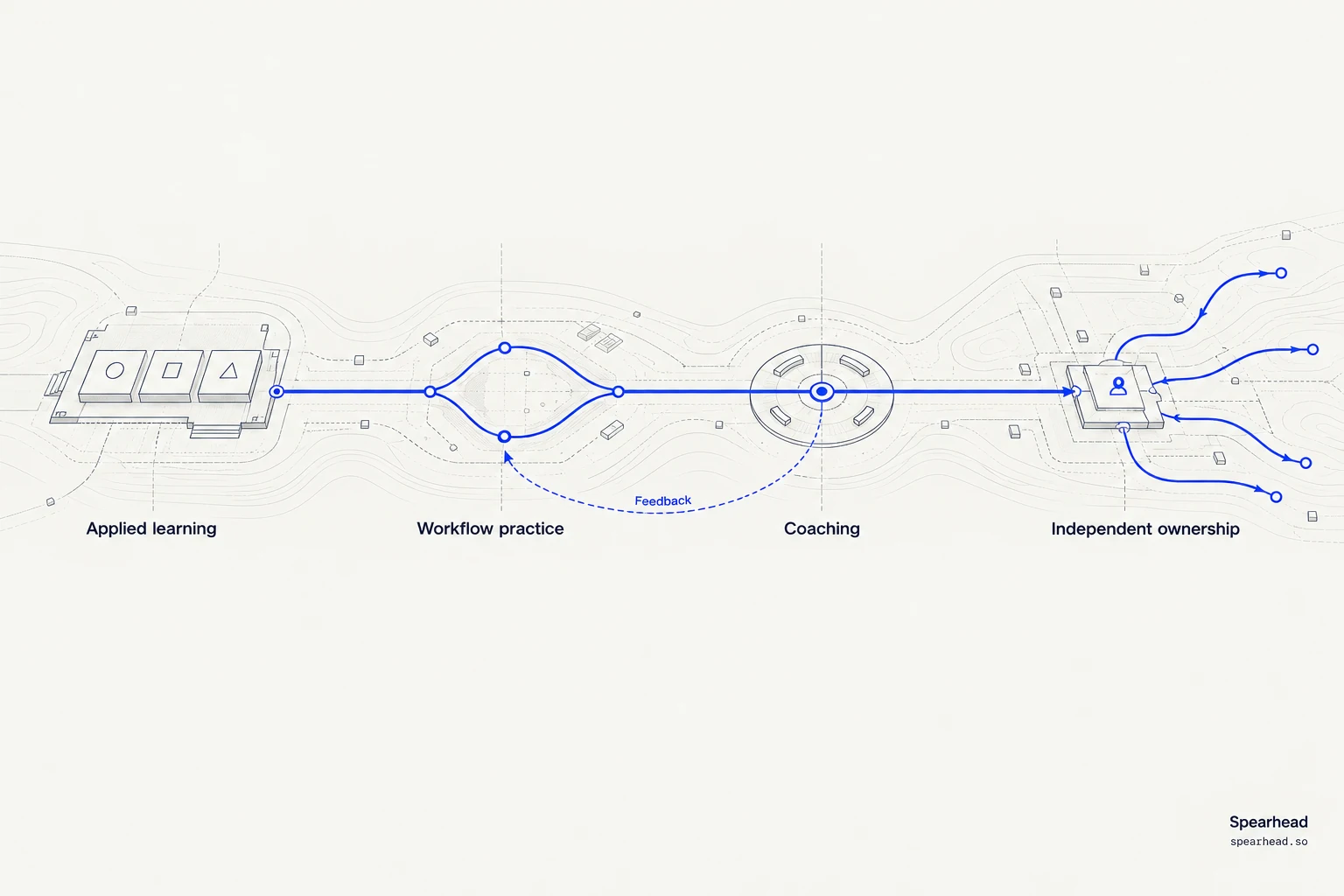
People need enough understanding to make decisions, enough practice to change their workflow, and enough support to work independently. We connect learning to the actual work being changed. AI Bootcamp and AI for Leaders provide distinct entry points, while adoption and capability transfer support strategy and engineering engagements.
A demonstration can create interest without changing how a team operates. A broad training program can leave participants unsure what they are allowed to use or how to judge an answer. Effective enablement starts with the audience, their decisions, approved tools, and a task they recognize. Follow-through belongs in the scope, rather than becoming an assumed benefit of attendance.
A view of the work
The connections that matter
- 01Applied learning
- 02Workflow practice
- 03Coaching
- 04Independent capability
Working together
What the work involves
- 01
AI Bootcamp
Build shared fluency and identify useful applications with a defined audience. Industry and function variants use relevant workflows and exercises. Preparation, permitted tools, format, and outputs are agreed for the cohort.
- 02
AI for Leaders
Use a cohort-based format for leadership decisions and applied workflow work. Connect what participants learn to investment, responsibilities, quality, and changes in how teams operate. Keep this distinct from a one-day Bootcamp itinerary.
- 03
Adoption in an engagement
Prepare affected people for a new workflow: explain the change, define their role, practice exceptions, and gather feedback. Measure use and quality against an agreed baseline instead of treating attendance as adoption.
- 04
Capability transfer
Help client teams understand and operate what has been built. Pair documentation with practical rehearsal, access checks, and a defined handover. Training needs to match the responsibility the team will inherit.
- 05
Learning that informs the next decision
Capture questions, workflow opportunities, and constraints. A program may identify the need for blueprinting, governance, or engineering; it does not oblige the client to buy a preset sequence.
Outputs and decisions
What you can take forward
- An audience-specific program and agreed learning objectives.
- Applied exercises using approved tools and information.
- Workflow opportunities, questions, and next decisions.
- A scoped adoption or transfer plan where included.
Illustrative example
Illustrative applied exercise
A leadership cohort could review a familiar reporting workflow, try an approved assistance pattern, and compare where human judgment remains essential. The output is a documented workflow proposal and the questions to resolve before implementation, rather than a promised deployed system.
Illustrative scenario, not a reported client result or a product capability claim.
Scope and responsibility
Agree on the scope
Program format, participant preparation, exercises, and follow-through are agreed for the engagement. Enablement does not replace governance approval or engineering validation. A useful learning experience can surface opportunities without proving their financial value or production readiness.
Practical questions
Before you begin
Should every team start with Bootcamp?
No. It is a useful entry when shared understanding is missing. Teams with a clear problem can begin with blueprinting, governance, architecture, or production readiness.
How does AI for Leaders differ?
It is cohort-based and connects leadership decisions to applied workflow work. The program’s exact activities and reinforcement are scoped separately from Bootcamp.
Can our team operate the system after delivery?
Capability transfer can be part of delivery. Define the roles, competence checks, documentation, access, and handover conditions as part of the engineering scope.
Explore this practice
Find the work you need
- AI Bootcamp
What should your team understand and try before deciding where AI belongs? Build practical fluency around relevant work, then turn the cohort’s exercises into useful opportunities, decisions and next steps.
- AI for Leaders
How do leaders move from personal AI use to better organizational work? Apply AI to real workflow questions, make sponsorship decisions and develop the capability to carry the work forward.
Next step
Start with the work you want to change.
Tell us who needs to make better decisions or change their work. We can match the audience to a program and agree on its practical outputs.
Discuss your priorities